Technology evolves rapidly, and every few years a new display innovation changes the way people experience entertainment, gaming, filmmaking, communication, and even education. One of the most exciting advancements shaping the modern digital era is 8K technology, often referred to as the next great horizon in visual experiences. The term “8K Horizon” represents more than just higher screen resolution—it symbolizes the future of ultra-realistic visuals, immersive entertainment ecosystems, and intelligent digital connectivity.
From next-generation televisions and cinematic productions to AI-enhanced streaming platforms and virtual reality applications, 8K is redefining the limits of visual clarity. While 4K displays became mainstream over the past decade, 8K technology is now stepping forward with astonishing levels of detail, vibrant color reproduction, and lifelike image quality.

What is 8K Horizon?
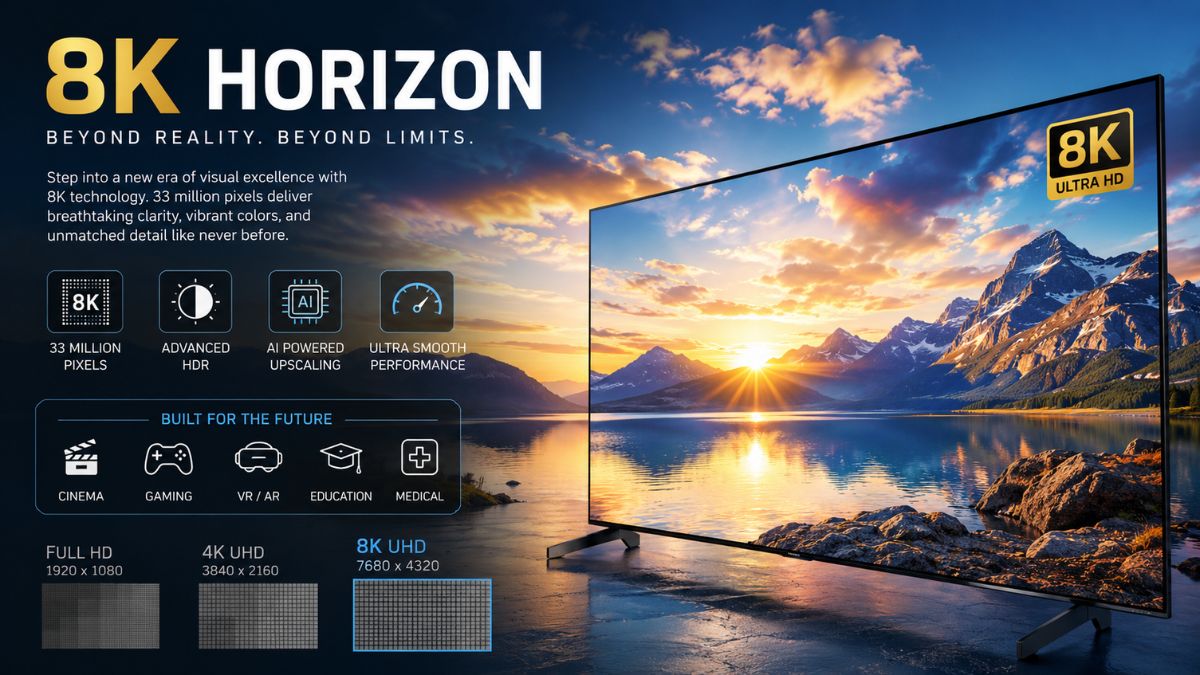
The phrase 8K Horizon refers to the emerging technological frontier driven by 8K resolution displays and content ecosystems. In simple terms, 8K resolution contains approximately 7680 × 4320 pixels, which equals more than 33 million pixels on a single screen.
This means:
- Four times the resolution of 4K
- Sixteen times the resolution of Full HD
- Sharper textures
- Greater depth perception
- Enhanced realism
The “horizon” aspect reflects the expanding possibilities made possible by this ultra-high-definition revolution.
Understanding 8K Resolution
To understand why 8K matters, it helps to compare it with previous display generations.
| Resolution Type | Pixel Dimensions | Total Pixels |
|---|---|---|
| HD | 1280 × 720 | 0.9 Million |
| Full HD | 1920 × 1080 | 2 Million |
| 4K UHD | 3840 × 2160 | 8.3 Million |
| 8K UHD | 7680 × 4320 | 33.2 Million |
The increase in pixel density dramatically improves image precision. Tiny details that were previously invisible become crystal clear in 8K displays.

Key Features of 8K Horizon Technology
1. Ultra-Realistic Visual Quality
The primary attraction of 8K technology is its remarkable realism. Images appear more natural because higher pixel density reduces visible pixelation.
Benefits include:
- Sharper edges
- Improved texture rendering
- More lifelike faces
- Enhanced color transitions
- Better depth perception
This is especially noticeable on large screens above 65 inches.
2. Advanced HDR Integration
Modern 8K systems typically include advanced HDR (High Dynamic Range) technologies such as:
- HDR10+
- Dolby Vision
- HLG
HDR enhances:
- Brightness levels
- Contrast ratios
- Color accuracy
- Shadow detail
Together, 8K resolution and HDR create a highly immersive viewing experience.
3. AI-Powered Upscaling
Native 8K content is still limited, so manufacturers use artificial intelligence to upscale lower-resolution content.
AI upscaling:
- Enhances sharpness
- Removes noise
- Improves textures
- Reconstructs missing details
- Optimizes image depth
Modern AI processors analyze scenes frame by frame to simulate near-8K quality from 4K or even HD content.

Applications of 8K Horizon Technology
Entertainment Industry
The entertainment sector is one of the biggest adopters of 8K technology.
Movies and Cinematography
Filmmakers use 8K cameras for:
- Greater editing flexibility
- Enhanced visual effects
- Superior cropping capabilities
- Detailed cinematic shots
Major studios increasingly capture footage in 8K to future-proof productions.
Streaming Platforms
Streaming companies are gradually preparing for 8K delivery as internet infrastructure improves globally.
Benefits include:
- Improved home cinema experiences
- Better large-screen streaming
- Enhanced sports broadcasting
- Realistic nature documentaries
Gaming Revolution
Gaming is entering a new era with 8K visuals.
Modern GPUs and gaming consoles are beginning to support:
- 8K rendering
- Ray tracing
- High refresh rates
- Ultra-low latency
Gamers benefit from:
- Better immersion
- Sharper textures
- Realistic environments
- Enhanced competitive visibility
Medical Imaging
8K displays improve:
- Surgical precision
- Diagnostic imaging
- Medical training
- Remote consultations
Doctors can analyze highly detailed scans with improved accuracy.
Applications include:
- Endoscopy
- Radiology
- Microsurgery
- Robotic surgery systems
Education and Research
Educational institutions use 8K displays for:
- Scientific visualization
- Virtual laboratories
- Engineering simulations
- Interactive learning
Students can observe microscopic details and complex models with incredible clarity.
Virtual Reality and Augmented Reality
VR and AR require high-resolution displays to reduce motion sickness and improve immersion.
8K technology helps by:
- Eliminating screen-door effects
- Improving realism
- Increasing visual comfort
- Enhancing simulation environments
This is important for:
- Training simulators
- Metaverse experiences
- Architecture visualization
- Military applications
The Role of Artificial Intelligence in 8K Horizon
Artificial intelligence is deeply connected to the success of 8K ecosystems.
AI assists in:
- Video compression
- Motion smoothing
- Upscaling
- Scene recognition
- Content optimization
Without AI, handling massive 8K data streams would be extremely difficult.
Machine learning models continuously improve display performance by learning user preferences and viewing patterns.
Challenges Facing 8K Adoption
Despite its advantages, 8K technology faces several obstacles.
1. High Hardware Costs
8K televisions, cameras, and monitors remain expensive.
Consumers often need:
- Premium GPUs
- Faster processors
- Advanced HDMI standards
- High-bandwidth internet
2. Limited Native 8K Content
The amount of true 8K content is still relatively small.
Challenges include:
- Expensive production workflows
- Massive storage requirements
- Slow content transition
- Streaming limitations
3. Bandwidth Requirements
Streaming 8K video requires enormous bandwidth.
Typical requirements:
- Stable fiber internet
- Advanced compression codecs
- High-speed Wi-Fi standards
Without strong infrastructure, 8K streaming becomes impractical.
4. Storage Demands
8K video files consume large amounts of storage space.
Professional creators often need:
- Enterprise SSD arrays
- Cloud rendering systems
- High-capacity servers
8K Horizon and Smart Cities
Future smart cities may integrate 8K technology into:
- Surveillance systems
- Public information displays
- Transportation monitoring
- Remote operations centers
Ultra-high-definition feeds improve:
- Traffic analysis
- Security monitoring
- Emergency response systems
Impact on Content Creators
Content creators are increasingly exploring 8K production.
Benefits include:
- Higher production quality
- Better editing flexibility
- Future-proof media archives
- Premium branding opportunities
YouTubers, filmmakers, and digital artists are beginning to embrace 8K workflows as audiences demand better quality experiences.
The Evolution of Display Technologies
The journey toward 8K Horizon evolved through multiple stages:
- CRT Displays
- Plasma TVs
- LCD Screens
- LED Technology
- OLED Displays
- QLED Panels
- Mini-LED Systems
- MicroLED Innovations
- 8K Ultra-HD Displays
Each generation improved:
- Brightness
- Color accuracy
- Power efficiency
- Viewing angles
- Response times

8K in Sports Broadcasting
Sports broadcasting greatly benefits from 8K clarity.
Advantages include:
- Sharper action scenes
- Improved slow-motion replay
- Better stadium immersion
- Enhanced viewer engagement
Large sporting events increasingly experiment with ultra-high-definition production systems.
Environmental Considerations
8K technology also raises environmental concerns.
Potential issues:
- Increased energy consumption
- Electronic waste
- Manufacturing resource demands
However, newer technologies are becoming more energy efficient through:
- Smarter processors
- AI optimization
- Improved panel efficiency
Sustainable innovation will be critical for the long-term future of 8K ecosystems.
Future Trends in 8K Horizon Technology
1. Wider Consumer Adoption
As manufacturing costs decrease, 8K displays will become more affordable.
2. Faster Internet Infrastructure
Global expansion of:
- Fiber networks
- Wi-Fi 7
- 6G research
will support smoother 8K streaming.
3. Cloud Gaming Integration
Cloud gaming services may eventually deliver 8K gaming experiences without requiring expensive local hardware.
4. AI-Generated Visuals
AI-generated content will combine with 8K rendering to create highly immersive digital environments.
5. Holographic Displays
Future innovations may move beyond flat screens toward holographic and spatial display technologies powered by ultra-high-resolution systems.
Is 8K Worth It?
The answer depends on user needs.
8K is ideal for:
- Professional creators
- Gamers
- Home theater enthusiasts
- Large-screen users
- Visual production industries
8K may not yet be necessary for:
- Casual viewers
- Small-screen setups
- Limited bandwidth users
However, as technology advances, 8K will likely become a mainstream standard just as 4K did previously.
Conclusion
The concept of 8K Horizon represents far more than increased screen resolution. It symbolizes the next stage of digital evolution where visual realism, artificial intelligence, immersive environments, and advanced connectivity merge into one powerful ecosystem.
Although challenges such as bandwidth limitations, hardware costs, and limited native content still exist, technological progress continues to push the industry forward. From entertainment and gaming to medicine, education, and smart cities, 8K technology is already influencing the future of human interaction with digital environments.
As AI, cloud computing, and network infrastructure continue to improve, the dream of seamless 8K experiences will become increasingly accessible to consumers around the world. The horizon of ultra-high-definition innovation is only beginning, and the future looks sharper, smarter, and more immersive than ever before.
For more info please visit: techomagazine.com