
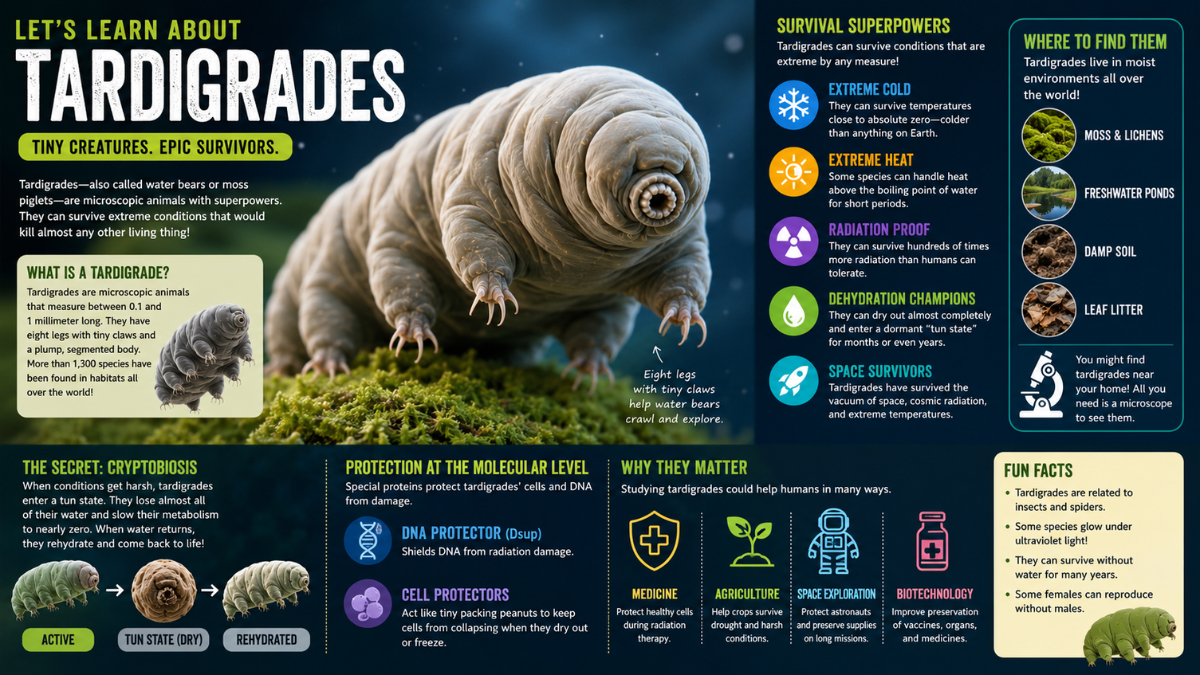
Tardigrades may be microscopic, but they are among the most fascinating organisms on Earth. Often called water bears or moss piglets, these tiny animals have captured the imagination of scientists, students, and nature lovers around the world. Despite being smaller than a grain of sand, tardigrades possess extraordinary survival abilities that seem almost impossible.
From surviving the freezing vacuum of space to enduring deadly radiation and extreme dehydration, tardigrades are living proof that nature can create life forms tougher than science fiction heroes. Researchers study them not only because they are unusual but also because they may help humanity solve future challenges involving medicine, climate change, food preservation, and even space travel.
Meet the Incredible Tardigrade

Tardigrades are incredibly small. Most measure between 0.1 and 1 millimeter long, meaning many are too tiny to see clearly with the naked eye. Yet inside their miniature bodies are surprisingly complex biological systems.
Scientists have identified more than 1,300 species of tardigrades, and new species continue to be discovered. They live almost everywhere on Earth:
- In moss and lichens
- On mountain peaks
- Deep in oceans
- In tropical rainforests
- In Antarctica
- In freshwater ponds
- In desert environments
Their ability to survive in such diverse habitats is one reason they are considered among the most resilient animals ever studied.
Why Are Tardigrades So Famous?
Most animals need stable conditions to survive. Humans, for example, can only tolerate a narrow range of temperatures, oxygen levels, and radiation exposure. Tardigrades, however, seem to ignore many of nature’s limits.
Scientists have tested tardigrades under conditions that would instantly kill most living organisms. Astonishingly, many survived.
Tardigrades Can Survive Space
- The vacuum of space
- Intense cosmic radiation
- Extreme temperatures
- Lack of oxygen
Many tardigrades survived for days and later recovered once returned to water. This shocked scientists because space is one of the harshest environments imaginable.
Their survival has made tardigrades important in astrobiology — the scientific study of life in space. Researchers now wonder whether life elsewhere in the universe might use similar survival mechanisms.
Masters of Extreme Survival
Tardigrades belong to a category of organisms known as extremophiles, creatures capable of surviving extreme conditions. However, tardigrades stand out even among extremophiles because they can survive multiple harsh conditions simultaneously.
Surviving Extreme Cold
Some tardigrades have survived temperatures close to absolute zero, colder than anything naturally found on Earth. At these temperatures, most biological systems freeze completely and become permanently damaged.
Yet tardigrades can pause their metabolism and enter a protective dormant state. When conditions improve, they “wake up” and continue living as if nothing happened.
Surviving Extreme Heat

This is remarkable because heat usually destroys proteins and DNA inside cells. Tardigrades protect their cells using specialized biological adaptations that scientists are still trying to fully understand.
The Secret Weapon: Cryptobiosis
The greatest survival trick of tardigrades is a process called cryptobiosis.
When their environment becomes dangerous — especially during dehydration — tardigrades lose almost all the water in their bodies and shrink into a dry, curled-up form called a tun state.
In this state:
- Their metabolism slows to almost zero
- They stop growing and reproducing
- Water leaves their cells
- Biological activity nearly stops
A tardigrade in cryptobiosis is not truly dead, but it exists in a suspended state between life and inactivity.
When water returns, the tardigrade rehydrates and becomes active again.
Scientists have revived tardigrades after years of dormancy, showing just how effective this survival strategy is.
How Tardigrades Protect Their DNA

Humans exposed to high levels of radiation can suffer severe illness or death. Tardigrades, however, can survive radiation doses hundreds of times higher than humans can tolerate.
Researchers discovered that tardigrades produce special proteins that shield their DNA from damage. One famous protein, often called Dsup (short for “damage suppressor”), acts like a protective barrier around genetic material.
Experiments have shown that introducing tardigrade proteins into human cells can reduce radiation damage. This discovery could someday help:
- Cancer patients undergoing radiation therapy
- Astronauts exposed to cosmic radiation
- Workers in high-radiation environments
The idea that a tiny microscopic animal could improve human medicine demonstrates the incredible value of studying unusual life forms.
Tiny Packing Peanuts Inside Cells
Another fascinating tardigrade adaptation involves proteins that protect cells during dehydration.
When cells lose water, they normally collapse or become damaged. Tardigrades avoid this problem using proteins that behave almost like microscopic packing material.
These proteins stabilize cell structures and keep them intact while water is absent. Once rehydrated, the cells function normally again.
Scientists believe these proteins could someday help preserve:
- Vaccines without refrigeration
- Human organs for transplant
- Sensitive medicines
- Food during long space missions
Such discoveries could revolutionize biotechnology and healthcare.
Where Can You Find Tardigrades?
They are especially common in moist environments such as:
- Moss growing on rocks
- Damp soil
- Lichens on tree bark
- Leaf litter
- Freshwater puddles
In fact, many people can find tardigrades near their own homes using simple equipment.
How to Find a Tardigrade
Scientists and hobbyists often collect small pieces of moss or lichen and soak them in water. After a few hours, they examine the water under a microscope.
With patience, tiny wriggling tardigrades may appear.
This makes tardigrades popular in classrooms and science projects because students can observe real microscopic animals using relatively simple tools.
Tardigrades and Space Exploration
As humans prepare for longer space missions, scientists increasingly study organisms capable of surviving harsh extraterrestrial environments.
Why Tardigrades Matter for Space Travel

- Radiation
- Extreme temperatures
- Isolation
- Limited water and food
Tardigrades may offer biological clues for solving these challenges.
Researchers are exploring whether tardigrade-inspired technologies could help:
- Protect astronauts from radiation
- Preserve food for long missions
- Improve crop survival in space
- Store medicines more efficiently
Although humans cannot become tardigrades, studying their biology may inspire future innovations.
Could Tardigrades Survive an Apocalypse?
Tardigrades are often called “apocalypse-proof,” though that phrase is partly exaggerated.
They are certainly tougher than most animals. Some scientists believe tardigrades could survive catastrophic events that would wipe out many other species, including:
- Global freezing
- Severe droughts
- Massive radiation exposure
- Asteroid impacts
However, even tardigrades have limits. They still need suitable conditions to reproduce and maintain long-term populations.
Still, their resilience raises fascinating questions about the boundaries of life itself.
What Do Tardigrades Eat?
Different species eat different foods.
Some tardigrades feed on:
- Plant cells
- Algae
- Moss fluids
- Tiny microorganisms
Others are predators that hunt smaller microscopic creatures.
They use specialized mouthparts to pierce cells and suck out nutrients, somewhat like miniature biological straws.
Despite their cute appearance, some tardigrades are surprisingly aggressive hunters in the microscopic world.
The Life Cycle of a Water Bear
Young tardigrades look similar to adults but are smaller. As they grow, they molt several times, shedding their outer layer much like insects do.
Scientists have even filmed baby tardigrades hatching and exploring their environment for the first time — a surprisingly adorable sight for a microscopic animal.
Depending on the species and environmental conditions, tardigrades may live from a few months to several years.
The Science Behind Their Toughness
Understanding tardigrades requires knowledge from multiple scientific fields:
- Biology
- Genetics
- Physics
- Chemistry
- Space science
Researchers study how tardigrade proteins interact with water, radiation, and cell structures. Advanced microscopes and genetic analysis tools have helped scientists uncover many of their secrets.
Yet many mysteries remain unanswered.
For example:
- How exactly do their cells recover after dehydration?
- Why are some species tougher than others?
- Could their abilities be replicated in other organisms?
These unanswered questions continue driving scientific research worldwide.
Tardigrades in Popular Culture
Because of their bizarre appearance and extreme survival abilities, tardigrades have become internet celebrities.
They appear in:
- Documentaries
- Cartoons
- Science fiction
- Educational videos
- Video games
People are fascinated by the idea that a creature so tiny can survive conditions humans cannot.
Their popularity has also helped increase public interest in microbiology and environmental science.
What Tardigrades Teach Us About Life
For centuries, humans assumed survival required relatively stable conditions. Tardigrades challenge that assumption. They show that evolution can produce extraordinary biological solutions to environmental stress.
Their existence also demonstrates an important scientific lesson:
Even the smallest organisms can hold enormous importance.
A microscopic creature living quietly in moss may someday help humanity:
- Improve medicine
- Preserve food
- Survive deep-space travel
- Understand the origins of life
That is why scientists continue studying these tiny animals with such enthusiasm.
Fun Facts About Tardigrades
Here are some quick facts that make tardigrades even more amazing:
- They have eight legs with tiny claws.
- They are related to arthropods like insects and spiders.
- Some species glow under ultraviolet light.
- They can survive without water for years.
- Their bodies are mostly water when active.
- They move slowly, which inspired their name.
- Some species reproduce without males.
- Fossil tardigrades are extremely rare because their bodies are so tiny and soft.
Can Humans Learn From Tardigrades?
Scientists increasingly believe that tardigrades may inspire future technologies.
Possible applications include:
Medicine
Tardigrade proteins may protect healthy cells during cancer treatment.
Agriculture
Their survival strategies could help develop drought-resistant crops.
Food Preservation
Understanding cryptobiosis could improve long-term food storage.
Biotechnology
Researchers hope to create better methods for preserving vaccines and biological materials.
Space Colonization
Tardigrade-inspired systems may support long-duration missions to Mars and beyond.
Although these applications are still being researched, the possibilities are exciting.
How Evolution Created a Survivor
Tardigrades did not evolve their abilities overnight.
Over millions of years, species living in environments that frequently dried out needed ways to survive dehydration. Gradually, natural selection favored individuals with better protection systems.
What began as a solution to drying conditions may have accidentally created one of the toughest animals on Earth.
This is one of evolution’s most fascinating features: adaptations developed for one challenge can unexpectedly provide advantages in entirely different situations.
The Future of Tardigrade Research
Future studies may reveal:
- Better DNA repair systems
- New protective proteins
- Improved preservation technologies
- Insights into extraterrestrial life
As scientific tools improve, tardigrades may become even more important in biology and medicine.
Final Thoughts
Tardigrades may be tiny, but their impact on science is enormous. These microscopic water bears challenge our understanding of life, survival, and adaptation.
They can endure radiation, freezing temperatures, dehydration, and even the vacuum of space. Yet they spend much of their lives quietly crawling through moss and damp soil, unnoticed by most people.
What makes tardigrades truly remarkable is not just their toughness, but what they teach us about resilience. Nature often hides its greatest innovations in the smallest places.
The next time you see moss growing on a rock or tree, remember: an entire hidden world may be living inside it — including one of the toughest creatures ever discovered on Earth.