The ocean covers more than 70% of Earth’s surface, yet for many people it remains one of the least understood parts of our planet. We admire beaches, enjoy seafood, and marvel at marine life documentaries, but few truly understand the science that explains how oceans function. That science is called oceanography — a fascinating field that connects climate, marine ecosystems, geology, chemistry, and even human survival.
For marine biologists and ocean researchers alike, oceanography offers a deeper understanding of the forces shaping life beneath the waves. While marine biology focuses on ocean organisms themselves, oceanography studies the entire marine system: the water, chemistry, currents, seafloor, climate interactions, and biological networks that make the ocean work as a living global engine.


What Is Oceanography?
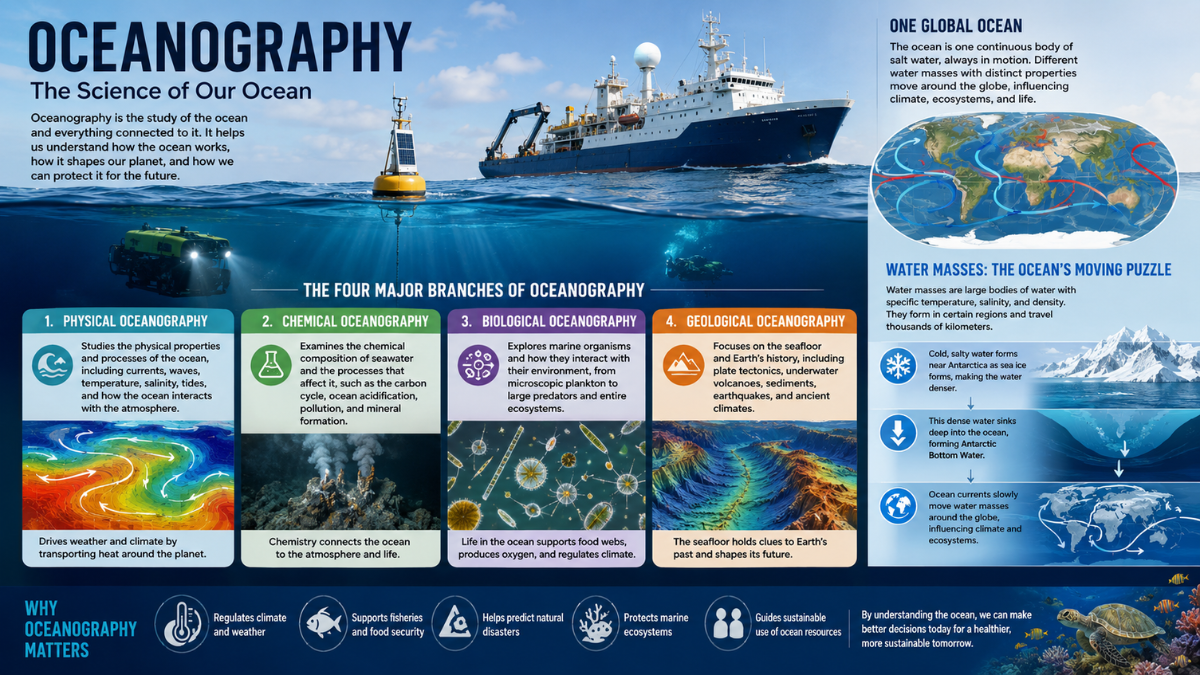
Oceanography is the scientific study of the ocean and everything connected to it. It explores how oceans move, how they influence weather and climate, how marine ecosystems function, and how the seafloor has changed over millions of years.
Rather than being a single discipline, oceanography combines several scientific fields into one interconnected study of Earth’s largest environment. Scientists generally divide oceanography into four major branches:
- Physical Oceanography
- Chemical Oceanography
- Biological Oceanography
- Geological Oceanography
Together, these branches help researchers understand the past, observe the present, and predict the future of our oceans.
The Ocean: One Giant Connected System
At first glance, oceans may appear to be separate bodies of water — the Atlantic, Pacific, Indian, Arctic, and Southern Oceans. In reality, however, they form one massive interconnected system of saltwater constantly moving around the globe.
One of the most important concepts in oceanography is the idea of water masses. A water mass is a large body of water with distinct characteristics such as:
- Temperature
- Salinity (salt content)
- Density
- Chemical composition
- Geographic origin
These differences matter because they determine how water moves through the global ocean system.
For example, very cold and salty water formed near Antarctica becomes extremely dense and sinks deep into the ocean. This process creates what scientists call Antarctic Bottom Water, one of the coldest and densest water masses on Earth.

Oceanography studies these movements and interactions to understand how our planet’s systems stay balanced.
The Four Major Branches of Oceanography
1. Physical Oceanography
Physical oceanography focuses on the movement and physical properties of seawater. This includes:
- Ocean currents
- Waves
- Tides
- Temperature patterns
- Salinity distribution
- Heat transfer
- Climate interactions
Physical oceanographers study how oceans absorb, store, and transport heat around the planet.
The ocean acts like a giant heat reservoir. Tropical waters near the equator absorb huge amounts of solar energy. Ocean currents then carry warm water toward colder regions near the poles, while cold water flows back toward the equator.
This circulation system helps regulate global temperatures and weather patterns.
Without ocean circulation:
- Many regions would experience extreme temperatures
- Weather systems would become more unstable
- Climate patterns would dramatically change
For example, the Gulf Stream transports warm water across the Atlantic Ocean, helping keep parts of Europe significantly warmer than they otherwise would be.
Ocean Currents and Climate
Ocean currents influence:
- Hurricanes
- Rainfall patterns
- Drought conditions
- Monsoons
- El Niño and La Niña events
Because oceans absorb large amounts of carbon dioxide and heat, physical oceanography is critical for understanding climate change.
2. Chemical Oceanography
Chemical oceanography examines the chemical composition of seawater and the interactions between marine chemicals, organisms, and the atmosphere.
This branch studies:
- Carbon cycling
- Oxygen levels
- Nutrient distribution
- Ocean acidification
- Pollution
- Hydrothermal vent chemistry
- Mineral formation
The ocean contains dissolved gases, minerals, and nutrients that support marine ecosystems and influence Earth’s atmosphere.
The Ocean and the Carbon Cycle
One of the most important areas of chemical oceanography is the carbon cycle.
The ocean absorbs enormous amounts of carbon dioxide from the atmosphere. Marine plants and plankton use this carbon during photosynthesis, while deep ocean waters store carbon for centuries.
However, increasing atmospheric carbon dioxide from human activities is causing ocean acidification — a major environmental challenge.
As oceans absorb more CO₂:
- Seawater becomes more acidic
- Coral reefs weaken
- Shell-forming organisms struggle to survive
- Marine ecosystems become stressed
Chemical oceanographers monitor these changes to understand their long-term impacts on marine life and climate systems.
Hydrothermal Vents
Another fascinating topic in chemical oceanography involves hydrothermal vents — underwater openings where superheated, mineral-rich water emerges from beneath the seafloor.
These vents create unique ecosystems filled with unusual organisms capable of surviving in extreme conditions.
Studying hydrothermal vents helps scientists learn about:
- Early Earth conditions
- Extreme life forms
- Mineral deposits
- Deep-sea ecosystems
3. Biological Oceanography
Biological oceanography explores how marine organisms interact with their environment.
While marine biology often focuses on individual species, biological oceanography examines the larger ecological relationships between living organisms and ocean systems.
This field studies:
- Plankton populations
- Food webs
- Marine productivity
- Ecosystem dynamics
- Nutrient cycling
- Oxygen production
Why Plankton Matter
Tiny drifting organisms called plankton are among the most important life forms on Earth.
Phytoplankton — microscopic plant-like organisms — perform photosynthesis and produce a significant portion of the planet’s oxygen.
They also form the foundation of marine food webs.
Biological oceanographers study how plankton populations change with:
- Temperature
- Nutrient availability
- Light levels
- Ocean circulation
Because plankton respond quickly to environmental changes, they serve as important indicators of ocean health.
Ocean Productivity
Scientists often measure chlorophyll concentrations to estimate biological productivity in the ocean.
Higher chlorophyll levels usually indicate:
- Greater photosynthesis
- More plankton growth
- Stronger marine ecosystems
These measurements help researchers monitor fisheries, ecosystem changes, and climate impacts.
4. Geological Oceanography
Geological oceanography focuses on the structure and history of the seafloor.
This branch studies:
- Plate tectonics
- Underwater volcanoes
- Sediment layers
- Earthquakes
- Ocean basins
- Fossils
- Underwater mountains and trenches
The seafloor is far more dynamic than many people realize.
The Hidden Landscape Beneath the Ocean
Beneath the waves lies a vast underwater world containing:
- Mountain ranges
- Deep trenches
- Volcanoes
- Canyons
- Spreading ridges
Scientists use sonar mapping and deep-sea exploration technology to study this hidden terrain, known as bathymetry.
Understanding seafloor geology helps researchers predict:
- Earthquakes
- Tsunamis
- Volcanic activity
- Coastal changes
Looking Into Earth’s Past
Marine sediments preserve records of Earth’s climate history spanning millions of years.
By analyzing these layers, geological oceanographers can study:
- Ancient climate conditions
- Ice ages
- Mass extinctions
- Changes in sea level
This information helps scientists predict how modern climate systems may change in the future.
Why Oceanography Matters
Oceanography is not just an academic subject — it directly affects life on Earth.
The ocean influences:
- Global climate
- Food production
- Weather systems
- Transportation
- Biodiversity
- Energy resources
- Coastal economies
Understanding the ocean helps societies prepare for environmental challenges and manage natural resources responsibly.
Climate Regulation
The ocean absorbs:
- Heat from the sun
- Atmospheric carbon dioxide
- Energy from weather systems
Without the ocean acting as a heat sink, Earth’s climate would be far more extreme.
Oceanographic research helps improve climate models and forecasts, making it possible to better predict hurricanes, droughts, floods, and rising sea levels.
Fisheries and Food Security
Billions of people rely on seafood as a major protein source.
Oceanographers help develop sustainable fishing practices by studying:
- Fish migration
- Ocean productivity
- Habitat conditions
- Ecosystem health
This research is critical for preventing overfishing and protecting marine biodiversity.
Natural Disaster Prediction
Oceanographic monitoring systems can help predict:
- Tsunamis
- Storm surges
- Coastal flooding
- Harmful algal blooms
These warning systems save lives and reduce economic damage.
Conservation and Environmental Protection
Oceanography also supports efforts to:
- Protect coral reefs
- Preserve marine habitats
- Reduce pollution
- Monitor climate impacts
- Develop marine protected areas
As human activities increasingly affect marine ecosystems, oceanographic research becomes more essential than ever.
Technology in Modern Oceanography
Modern oceanographers use advanced tools and technologies to study the ocean in ways that were impossible decades ago.
These include:
- Autonomous underwater vehicles (AUVs)
- Remotely operated vehicles (ROVs)
- Satellite imaging
- Sonar systems
- Ocean buoys
- Underwater drones
- Computer simulations
Deep-sea expeditions continue to reveal previously unknown species, ecosystems, and geological formations.
Oceanography and the Future
The future of humanity is closely tied to the future of the ocean.
As climate change, pollution, and overfishing continue to threaten marine systems, oceanography provides the knowledge needed to make informed decisions.
Future oceanographic research will play a key role in:
- Climate adaptation
- Renewable ocean energy
- Sustainable fisheries
- Marine conservation
- Coastal protection
- Disaster preparedness
The ocean remains one of Earth’s greatest mysteries. Vast regions of the deep sea are still unexplored, meaning scientists are continually discovering new ecosystems and processes.
Final Thoughts
Oceanography is far more than the study of water. It is the science of an interconnected planetary system that shapes weather, climate, ecosystems, and life itself.
From the movement of deep ocean currents to microscopic plankton drifting near the surface, every component of the marine environment plays a role in maintaining Earth’s balance.
Understanding oceanography helps us better understand our planet — and ourselves.
As technology advances and exploration continues, oceanographers will remain at the forefront of efforts to protect marine ecosystems, predict environmental change, and secure a sustainable future for generations to come.