Health is often discussed in terms of nutrition, exercise, sleep, and medicine. Yet there is another powerful influence on human well-being that many people rarely think about: the Earth itself. The soil beneath our feet, the minerals in our water, the air we breathe, and even the landscapes around us quietly shape our physical and mental health every day. This fascinating relationship is where jiolojia, or geology, enters the conversation.
At first glance, geology may seem far removed from healthcare. Most people associate it with rocks, mountains, volcanoes, and earthquakes rather than hospitals or wellness. However, geology and health are deeply connected in ways that affect millions of lives worldwide. From the minerals our bodies need to function to environmental hazards that can trigger disease, geological factors play a significant role in public health.
In recent years, scientists and health experts have started paying closer attention to how Earth systems influence human wellness. This growing field, often called medical geology, explores how natural geological materials and processes impact human health. The findings are surprising, powerful, and increasingly important in our modern world.
This article takes a deep dive into jiolojia and its relationship with health. We will explore how geological environments affect nutrition, mental health, disease prevention, environmental safety, and overall quality of life. Along the way, we will also discover how understanding the Earth can help us build healthier communities and a more sustainable future.
What Does Jiolojia Mean?
The word “jiolojia” comes from the concept of geology, the scientific study of the Earth. It focuses on understanding rocks, minerals, landscapes, water systems, and the natural forces that shape our planet over time.
Geology helps explain:
- How mountains form
- Why earthquakes happen
- How groundwater moves
- Where minerals come from
- How soil develops
- Why certain regions experience natural disasters
Although geology is often associated with exploration and natural science, its influence extends far beyond academic research. Geological conditions can affect agriculture, drinking water, climate resilience, housing safety, and even disease patterns.
In simple terms, jiolojia helps us understand the environment we live in, and because humans depend completely on the environment for survival, geology naturally becomes connected to health.
The Surprising Link Between Geology and Human Health
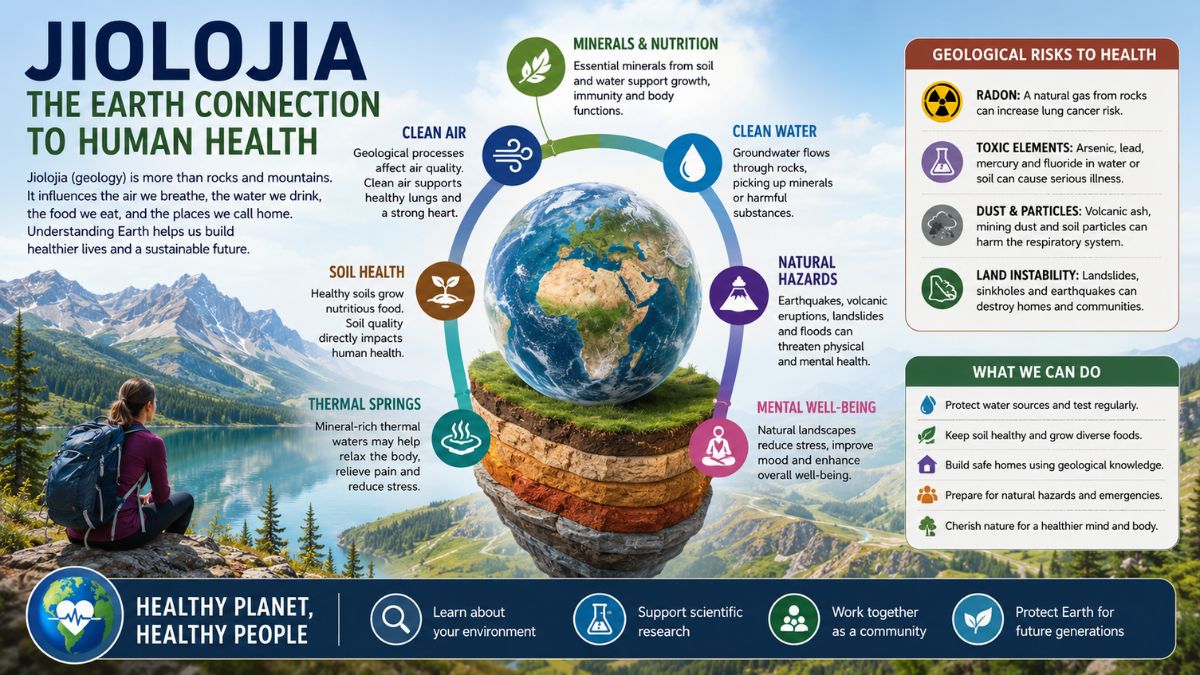
Human health does not exist in isolation. Every person is influenced by the environment around them. Geological systems affect our health through several pathways, including:
- Water quality
- Air quality
- Soil composition
- Mineral exposure
- Natural radiation
- Climate and landscape conditions
Some geological factors support health, while others create serious risks.
For example:
- Mineral-rich soils can improve nutrition.
- Contaminated groundwater can spread disease.
- Volcanic ash can damage lungs.
- Natural hot springs may support relaxation and healing.
- Certain rocks release harmful gases like radon.
These examples show that the Earth is not just a physical backdrop for human life. It actively interacts with our bodies and communities.
Medical Geology: A Growing Field
Medical geology is an emerging scientific discipline that studies the relationship between geological materials and human health.
Experts in this field examine questions such as:
- How do minerals affect nutrition?
- Why do certain diseases appear in specific geographic areas?
- How does pollution move through soil and water?
- What health risks come from mining activities?
- How can natural disasters affect long-term wellness?
Medical geology combines knowledge from:
- Geology
- Medicine
- Public health
- Environmental science
- Toxicology
- Hydrology
This interdisciplinary approach helps scientists better understand health patterns linked to environmental conditions.
Minerals: Tiny Elements with Huge Health Effects
The human body relies on minerals for nearly every biological process. Interestingly, these essential minerals originate from the Earth itself.
Some important minerals include:
| Mineral | Health Role |
|---|---|
| Calcium | Bone strength |
| Iron | Oxygen transport |
| Zinc | Immune support |
| Magnesium | Muscle and nerve function |
| Potassium | Heart health |
| Selenium | Antioxidant protection |
These minerals enter our bodies through food and water, which are directly influenced by soil and geological conditions.
Regions with nutrient-rich soils often produce healthier crops, while mineral-poor soils may contribute to nutritional deficiencies.
When Soil Affects Nutrition
Healthy soil creates healthy food.
Plants absorb minerals from the soil, and humans absorb those minerals by eating plants or animals that consume those plants.
If soil lacks certain nutrients, entire populations may experience health problems.
For example:
- Iodine-deficient soils can lead to thyroid disorders.
- Selenium deficiency may weaken immune function.
- Iron-poor soils can contribute to anemia.
This connection highlights how geology quietly shapes public health at a large scale.
Farmers, nutritionists, and environmental scientists increasingly recognize the importance of maintaining healthy soil ecosystems to support long-term wellness.
Water Quality and Geological Conditions
Groundwater flows through layers of rock and soil before reaching wells, springs, and drinking supplies. During this journey, water absorbs minerals and chemical compounds from the Earth.
Sometimes this process improves water quality by adding beneficial minerals. Other times it introduces dangerous contaminants.
Common geological contaminants include:
- Arsenic
- Fluoride
- Lead
- Mercury
- Radon
Long-term exposure to contaminated water can increase the risk of:
- Cancer
- Neurological disorders
- Kidney disease
- Developmental problems
- Bone disorders
One of the most well-known examples involves arsenic contamination in groundwater, which affects millions of people globally.
The Health Risks of Airborne Geological Particles
Tiny particles from soil, dust, volcanic ash, and mining activities can enter the air and affect respiratory health.
Breathing contaminated air may increase the risk of:
- Asthma
- Chronic bronchitis
- Lung disease
- Allergies
- Cardiovascular problems
Certain natural minerals, such as asbestos, are especially dangerous when inhaled.
Although asbestos was once widely used in construction materials, prolonged exposure is now known to cause severe lung diseases and cancers.
This demonstrates how geological materials can directly influence public health when disturbed or improperly managed.
Radon: The Invisible Geological Threat
Radon is a naturally occurring radioactive gas released from certain rocks and soils.
Because it is colorless and odorless, many people are unaware of its presence. However, prolonged exposure to high radon levels can significantly increase the risk of lung cancer.
Radon commonly enters homes through:
- Cracks in foundations
- Basements
- Underground water systems
Many countries now recommend radon testing in homes, particularly in regions with high geological risk.
This is another powerful example of how geology can affect everyday health without people realizing it.
Volcanic Activity and Human Health
Volcanoes are among the most dramatic geological events on Earth. While volcanic landscapes can be beautiful and fertile, eruptions also create major health risks.
Volcanic ash contains microscopic particles that can irritate:
- Eyes
- Skin
- Airways
- Lungs
Large eruptions may also release toxic gases such as:
- Sulfur dioxide
- Carbon dioxide
- Hydrogen sulfide
Communities near active volcanoes often face both immediate and long-term health challenges.
However, volcanic soils can also become highly fertile over time, supporting agriculture and food production.
This balance between danger and benefit is a recurring theme in jiolojia and health.
Natural Disasters and Mental Health
Geological events do not only affect physical health. They can also deeply impact mental and emotional well-being.
Earthquakes, landslides, tsunamis, and volcanic eruptions may cause:
- Anxiety
- Depression
- Trauma
- Sleep disorders
- Post-traumatic stress disorder (PTSD)
Survivors often face emotional stress long after the disaster itself ends.
Communities recovering from geological disasters may struggle with:
- Displacement
- Financial hardship
- Loss of loved ones
- Housing instability
Mental health support is therefore an essential part of disaster response and recovery.
The Healing Power of Natural Landscapes
Interestingly, geology can also support mental wellness in positive ways.
Natural environments such as:
- Mountains
- Beaches
- Forests
- Rivers
- Mineral springs
have long been associated with relaxation and healing.
Research suggests that spending time in nature may help reduce:
- Stress
- Anxiety
- Blood pressure
- Mental fatigue
Geological landscapes encourage outdoor activity, social connection, and emotional restoration.
This explains why many wellness retreats and therapeutic centers are located in scenic natural environments.
Hot Springs and Therapeutic Waters
Throughout history, people have traveled to mineral-rich hot springs seeking relief from pain and illness.
Geothermal waters often contain minerals such as:
- Sulfur
- Magnesium
- Calcium
- Sodium
Some studies suggest that bathing in mineral-rich waters may help improve:
- Joint pain
- Circulation
- Muscle tension
- Skin conditions
- Stress levels
Although hot springs are not a replacement for medical treatment, many people find them beneficial for relaxation and recovery.
This tradition demonstrates another fascinating connection between geology and human health.
Climate Change and Geological Health Risks
Climate change is increasing the importance of understanding geological health risks.
Rising temperatures and environmental changes can intensify:
- Soil erosion
- Flooding
- Drought
- Landslides
- Wildfires
- Water contamination
These changes may threaten food security, clean water access, and public health systems.
Geologists and environmental scientists are now working closely with healthcare experts to develop strategies for climate resilience and disaster preparedness.
Mining and Community Health
Mining provides important resources for modern society, including metals used in technology, medicine, and construction.
However, poorly managed mining operations can create serious health risks.
Potential dangers include:
- Water pollution
- Air contamination
- Heavy metal exposure
- Noise pollution
- Occupational hazards
Communities living near mining areas may experience higher rates of respiratory illness and environmental stress.
Responsible mining practices and environmental regulations are essential for protecting public health.
Urban Geology and Healthy Cities
Modern cities are also shaped by geology.
Urban planners and engineers must consider:
- Ground stability
- Flood risks
- Soil composition
- Earthquake zones
- Water availability
Building cities without understanding geological conditions can increase disaster vulnerability and health risks.
Healthy urban planning includes:
- Safe building design
- Green spaces
- Clean water systems
- Pollution control
- Climate adaptation measures
Geology therefore plays a hidden but critical role in creating safe and healthy communities.
Nutrition, Agriculture, and Geological Diversity
Different regions produce different crops partly because of geological conditions.
Volcanic soils, for example, are often highly fertile and rich in nutrients. This supports healthy agriculture and food diversity.
Meanwhile, dry or mineral-poor regions may struggle with:
- Reduced crop yields
- Nutritional deficiencies
- Food insecurity
Understanding geological conditions can help farmers improve sustainable agriculture and protect long-term food supplies.
How Jiolojia Supports Public Health Research
Public health researchers increasingly use geological data to track disease patterns and environmental risks.
This information helps governments and organizations:
- Identify contamination hotspots
- Improve water safety
- Predict natural disaster impacts
- Plan healthier communities
- Develop environmental policies
Medical geology is becoming especially important in developing countries where environmental exposure risks may be higher.
Environmental Awareness and Preventive Health
One of the biggest lessons from jiolojia is that prevention matters.
Understanding environmental risks early can prevent serious health problems later.
Examples include:
- Testing drinking water
- Monitoring air quality
- Evaluating soil contamination
- Improving disaster preparedness
- Regulating industrial pollution
Preventive environmental health strategies save lives and reduce healthcare costs.
The Role of Education
Public awareness about environmental health remains limited in many regions.
Teaching people about the relationship between geology and health can encourage:
- Safer housing decisions
- Better environmental practices
- Healthier agricultural methods
- Stronger disaster preparedness
Schools, universities, and public health programs all play an important role in spreading this knowledge.
Technology and the Future of Medical Geology
Modern technology is transforming how scientists study geological health risks.
New tools include:
- Satellite monitoring
- Geographic Information Systems (GIS)
- AI-based environmental modeling
- Remote sensing
- Advanced groundwater testing
These technologies help researchers detect hazards more quickly and respond more effectively.
Artificial intelligence is also helping predict environmental changes that may impact human health in the future.
Why Jiolojia Matters More Than Ever
Today’s world faces growing environmental challenges, including:
- Climate change
- Urbanization
- Pollution
- Resource depletion
- Natural disasters
These issues directly affect human health Jiolojia.
Jiolojia reminds us that human well-being is deeply connected to the planet we live on. Protecting environmental systems is therefore not only an ecological responsibility but also a public health necessity.
Building a Healthier Relationship with the Earth
A healthier future requires balance between human development and environmental protection.
This includes:
- Sustainable agriculture
- Clean energy
- Responsible mining
- Safe urban planning
- Water conservation
- Climate resilience
By understanding geological systems, societies can make smarter decisions that protect both people and the environment.
Final Thoughts
Jiolojia may seem like a scientific topic focused only on rocks and landscapes, but its influence reaches into nearly every aspect of human health. The minerals in our food, the quality of our water, the air we breathe, and the safety of our communities are all shaped by geological processes.
From supporting nutrition and mental wellness to identifying environmental hazards and disaster risks, geology quietly affects our lives every day.
As awareness of environmental health continues growing, the connection between jiolojia and human well-being will become even more important. Understanding the Earth is not just about studying the planet. It is also about protecting human life, improving public health, and building a more sustainable future for generations to come.
Ultimately, jiolojia teaches us a simple but powerful truth: human health and Earth health are inseparable.