
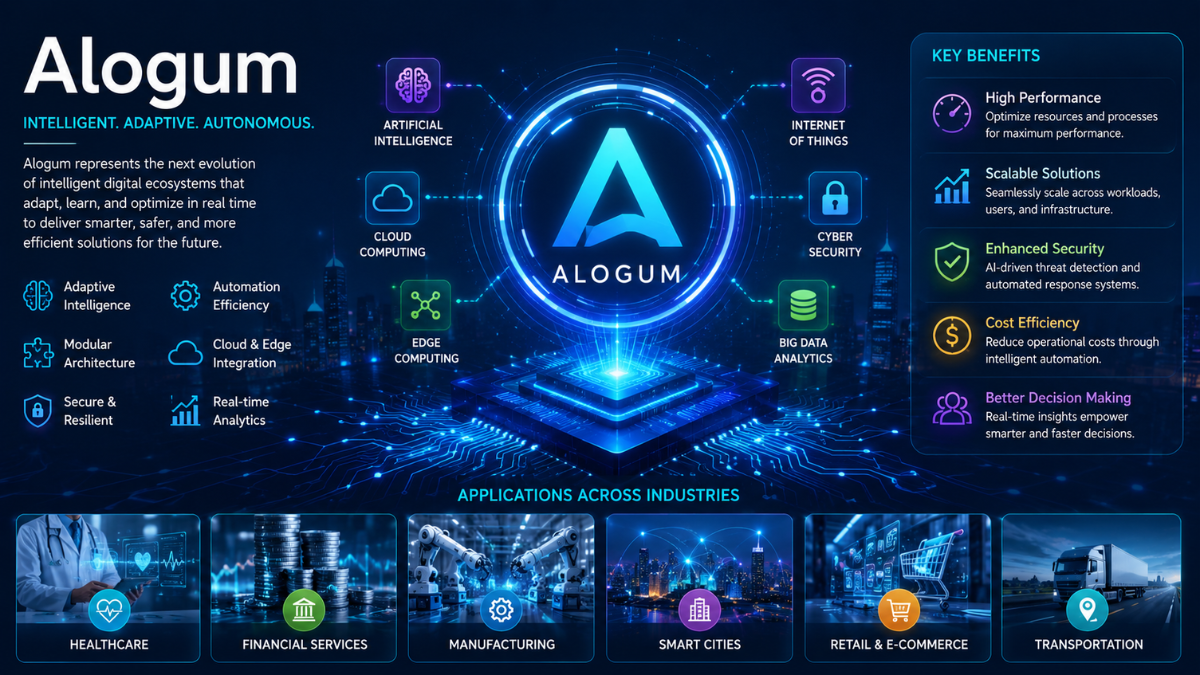
Technology evolves rapidly, but every once in a while, a new concept emerges that captures attention because of its flexibility, mystery, and future potential. One of those rising concepts is Alogum. Although the term may still sound unfamiliar to many people, discussions around Alogum are growing across technology communities, software development circles, digital transformation forums, and AI-focused innovation spaces.
Alogum represents more than just a single tool or platform. It reflects a broader technological philosophy centered around adaptive intelligence, modular systems, automation efficiency, and scalable digital ecosystems. In modern computing environments where businesses rely heavily on cloud infrastructure, machine learning, automation pipelines, cybersecurity frameworks, and intelligent analytics, concepts like Alogum are becoming increasingly important.
The digital era demands systems that can think, adapt, learn, optimize, and scale without requiring constant manual intervention. Traditional static software architectures are slowly giving way to dynamic, responsive, and context-aware infrastructures. Alogum fits naturally into this transformation because it symbolizes technological adaptability combined with algorithmic intelligence.
This article explores Alogum in depth, including its meaning, possible technological interpretations, applications, architecture, benefits, challenges, and future potential. Whether viewed as a framework, methodology, platform, or conceptual ecosystem, Alogum represents the next stage of intelligent digital evolution.
Understanding the Meaning of Alogum
The term Alogum can be interpreted in several ways depending on the context in which it is used. In technology discussions, it is often associated with adaptive algorithms, intelligent modular systems, and automation-driven infrastructures.
At its core, Alogum can be understood as a fusion of:
- Algorithmic intelligence
- Adaptive automation
- Modular digital architecture
- Unified system integration
- Machine-driven optimization
The name itself feels futuristic because it blends the structured logic of algorithms with the flexibility of scalable systems. Many modern technologies today are moving toward platforms that can self-adjust based on environmental inputs, user behavior, workload demands, and operational objectives. Alogum represents that transition from rigid software to intelligent ecosystems.
Instead of viewing software as a fixed product, Alogum encourages developers and organizations to see technology as a continuously evolving entity capable of optimization and autonomous improvement.
The Rise of Adaptive Digital Ecosystems
The technology industry has entered an age where adaptability matters more than ever. Businesses now operate in environments filled with:
- Massive datasets
- Real-time analytics
- Distributed cloud systems
- AI-powered automation
- Cybersecurity threats
- User personalization demands
- Cross-platform integrations
Traditional monolithic systems struggle under these conditions because they are difficult to scale and modify quickly. Adaptive ecosystems solve this problem by enabling components to communicate intelligently and evolve independently.
Alogum fits perfectly into this movement because it emphasizes:
- Intelligent coordination
- Autonomous processing
- Dynamic resource allocation
- Predictive optimization
- Real-time adaptability
Organizations increasingly need infrastructures that can handle unpredictable workloads while maintaining performance and security. Alogum-like systems are designed precisely for this challenge.
How Alogum Connects with Artificial Intelligence
Artificial intelligence plays a central role in the Alogum philosophy. Modern AI systems are no longer limited to isolated tasks like image recognition or recommendation engines. Instead, AI is becoming deeply integrated into entire operational ecosystems.
Alogum-based environments may use AI for:
- Predictive maintenance
- Workflow optimization
- Behavioral analytics
- Automated scaling
- Intelligent routing
- Threat detection
- Resource balancing
- Decision support systems
Machine learning models continuously analyze patterns and improve operational efficiency. This creates infrastructures capable of learning from historical behavior while adapting to new conditions in real time.
For example, an Alogum-driven cloud platform could automatically:
- Detect abnormal traffic spikes
- Reallocate computing resources
- Prevent system overload
- Identify suspicious activity
- Optimize data delivery speeds
All of these processes could occur without manual intervention.
This level of intelligence significantly reduces operational inefficiencies while improving user experience and infrastructure reliability.
The Role of Modular Architecture in Alogum
One of the defining characteristics of Alogum is modular architecture.
Modern software development increasingly relies on modular systems because they allow organizations to:
- Scale faster
- Deploy updates independently
- Improve system resilience
- Reduce downtime
- Simplify maintenance
- Increase development flexibility
Rather than building one enormous application, developers create interconnected modules that communicate through APIs and shared protocols.
In an Alogum framework, modularity becomes even more intelligent because modules can:
- Self-optimize
- Dynamically communicate
- Prioritize workloads
- Share analytical insights
- Adapt behavior automatically
This creates highly responsive digital ecosystems capable of handling changing demands with minimal disruption.
For example, an e-commerce platform built on Alogum principles could independently optimize:
- Inventory systems
- Recommendation engines
- Customer analytics
- Payment processing
- Security monitoring
- Logistics coordination
Each component operates semi-independently while contributing to the larger ecosystem.
Alogum and Cloud Computing
Cloud computing forms the backbone of many modern intelligent systems, making it a natural partner for Alogum.
Cloud infrastructures provide:
- Elastic scalability
- Distributed computing power
- Remote accessibility
- Automated deployment
- Data redundancy
- Infrastructure flexibility
Alogum enhances cloud systems by introducing intelligent automation and adaptive orchestration mechanisms.
Traditional cloud management often requires administrators to manually configure scaling policies, resource allocation, and monitoring thresholds. Alogum-based systems can automate these tasks using AI-driven analytics.
Imagine a cloud environment that automatically:
- Predicts traffic surges
- Adjusts server capacity
- Balances global workloads
- Minimizes latency
- Reduces operational costs
This creates highly efficient infrastructures that respond proactively rather than reactively.
As organizations continue migrating toward hybrid and multi-cloud environments, adaptive orchestration platforms inspired by Alogum principles may become increasingly valuable.
Cybersecurity in the Age of Alogum
Cybersecurity has become one of the most critical challenges in modern technology. As systems grow more connected, threat surfaces expand dramatically.
Traditional security approaches often rely on static rules and reactive defense mechanisms. However, modern cyber threats evolve constantly, making adaptive security essential.
Alogum introduces a more intelligent security philosophy by combining:
- Behavioral analytics
- AI-driven threat detection
- Predictive risk analysis
- Automated response systems
- Dynamic authentication frameworks
Instead of waiting for attacks to occur, Alogum-inspired systems can identify unusual behavior patterns before major breaches happen.
For example, such systems may detect:
- Abnormal login locations
- Suspicious data transfer activity
- Irregular application behavior
- Unauthorized privilege escalation
- Unusual network communication patterns
Once detected, automated containment strategies can activate instantly.
This reduces response times dramatically while minimizing damage.
The future of cybersecurity likely depends heavily on adaptive intelligence systems similar to Alogum architectures.
Alogum and Big Data Analytics
Modern organizations generate enormous amounts of data every second. Extracting value from this data requires advanced analytics systems capable of handling massive complexity.
Alogum complements big data environments by enabling:
- Real-time processing
- Predictive analytics
- Intelligent categorization
- Automated pattern recognition
- Dynamic reporting systems
Traditional analytics platforms often focus primarily on historical data interpretation. Alogum expands this capability into predictive and adaptive intelligence.
For example, businesses using Alogum-based analytics could:
- Forecast customer behavior
- Predict equipment failures
- Detect fraud patterns
- Optimize supply chains
- Improve marketing strategies
The combination of AI, automation, and scalable analytics creates smarter decision-making environments.
This allows organizations to move from reactive management toward proactive strategic planning.
Software Development in an Alogum Environment
Software engineering continues evolving rapidly. Agile development, DevOps practices, containerization, and CI/CD pipelines have transformed how applications are built and deployed.
Alogum introduces another layer of intelligence into development ecosystems.
Possible Alogum-driven development features include:
- AI-assisted debugging
- Autonomous code optimization
- Intelligent deployment orchestration
- Predictive testing frameworks
- Self-healing applications
- Adaptive infrastructure management
Development teams increasingly rely on automation to accelerate productivity. Alogum takes this idea further by enabling systems that learn from operational behavior and continuously improve themselves.
For instance, an intelligent deployment platform could automatically:
- Detect inefficient code patterns
- Recommend architecture improvements
- Optimize infrastructure allocation
- Predict deployment risks
- Roll back unstable updates autonomously
This significantly enhances software reliability and operational efficiency.
Alogum and the Internet of Things
The Internet of Things (IoT) connects billions of devices globally, including:
- Smart home systems
- Industrial sensors
- Healthcare monitors
- Autonomous vehicles
- Environmental tracking systems
- Smart city infrastructure
Managing these massive device ecosystems requires intelligent coordination and automation.
Alogum provides a conceptual framework for handling complex IoT environments by enabling:
- Device orchestration
- Predictive maintenance
- Intelligent communication routing
- Real-time monitoring
- Adaptive resource management
For example, a smart city powered by Alogum-inspired systems could dynamically manage:
- Traffic signals
- Energy distribution
- Public transportation
- Environmental monitoring
- Emergency response systems
These interconnected infrastructures could continuously optimize themselves using real-time analytics.
The result is greater efficiency, sustainability, and operational resilience.
Edge Computing and Alogum
Edge computing processes data closer to where it is generated rather than relying entirely on centralized cloud systems.
This approach reduces:
- Latency
- Bandwidth usage
- Data transmission delays
- Infrastructure bottlenecks
Alogum complements edge computing by enabling intelligent local decision-making.
In edge environments, adaptive systems may:
- Analyze sensor data locally
- Prioritize urgent processing tasks
- Reduce unnecessary cloud communication
- Optimize network performance
- Maintain operational continuity during connectivity disruptions
For example, autonomous drones using Alogum principles could independently:
- Detect obstacles
- Adjust flight paths
- Coordinate swarm behavior
- Optimize battery usage
- Analyze environmental conditions
This decentralized intelligence becomes especially important for mission-critical applications.
Alogum in Healthcare Technology
Healthcare technology increasingly depends on intelligent digital systems.
Modern healthcare infrastructures use:
- Electronic medical records
- AI-assisted diagnostics
- Remote monitoring
- Predictive analytics
- Robotic surgery systems
- Telemedicine platforms
Alogum-based architectures can improve healthcare operations by enabling smarter integration and automation.
Potential applications include:
- Real-time patient monitoring
- Automated anomaly detection
- Predictive disease analysis
- Intelligent hospital resource management
- Personalized treatment recommendations
For example, hospital systems could automatically:
- Predict patient admission surges
- Optimize staff scheduling
- Monitor equipment health
- Detect abnormal patient conditions
This improves healthcare efficiency while supporting better patient outcomes.
Financial Technology and Alogum
Financial technology systems require extreme reliability, security, and scalability.
Alogum concepts fit naturally into fintech environments because they support:
- Real-time transaction analysis
- Fraud detection
- Risk assessment
- Intelligent portfolio management
- Automated compliance monitoring
Modern financial ecosystems generate enormous transaction volumes that require intelligent processing.
Alogum-driven fintech systems may continuously analyze:
- Market trends
- User behavior
- Risk patterns
- Transaction anomalies
This creates more responsive and secure financial infrastructures.
For example, adaptive banking systems could instantly identify suspicious activities and initiate automated protective measures before fraud spreads.
The Importance of Automation in Alogum
Automation is one of the strongest pillars of Alogum.
Modern organizations increasingly depend on automation because manual processes are often:
- Slow
- Expensive
- Error-prone
- Difficult to scale
Alogum expands automation beyond simple scripted tasks.
Instead of following rigid instructions, adaptive automation systems can:
- Learn from patterns
- Improve workflows
- Predict failures
- Adjust operational behavior dynamically
Examples include:
- Intelligent customer service systems
- Autonomous infrastructure monitoring
- AI-powered manufacturing optimization
- Self-managing cloud environments
The result is greater efficiency and reduced operational complexity.
Alogum and Human-Machine Collaboration
Despite increasing automation, human expertise remains essential.
Alogum does not aim to eliminate human involvement. Instead, it enhances human-machine collaboration.
Adaptive systems can assist humans by:
- Providing intelligent recommendations
- Reducing repetitive tasks
- Enhancing situational awareness
- Supporting strategic decisions
- Improving operational visibility
For example:
- Engineers receive predictive maintenance alerts
- Analysts gain AI-generated insights
- Doctors obtain diagnostic assistance
- Cybersecurity teams receive automated threat prioritization
This creates collaborative ecosystems where humans focus on creativity, strategy, and complex reasoning while machines handle repetitive optimization tasks.
Challenges Facing Alogum-Based Systems
Although Alogum offers exciting possibilities, several challenges remain.
Complexity
Highly adaptive systems can become difficult to manage and understand.
Organizations must ensure transparency and maintainability.
Data Privacy
AI-driven ecosystems rely heavily on data collection and analytics.
This raises concerns about:
- User privacy
- Regulatory compliance
- Ethical data usage
Security Risks
Intelligent systems themselves can become targets for cyberattacks.
Protecting AI-driven infrastructures requires advanced security mechanisms.
Infrastructure Costs
Building adaptive ecosystems may require significant investments in:
- Cloud infrastructure
- AI development
- Skilled engineering teams
- Data management systems
Ethical Concerns
Automated decision-making systems raise important ethical questions regarding:
- Bias
- Accountability
- Transparency
- Fairness
Organizations must carefully address these concerns.
The Future Potential of Alogum
The future of Alogum appears highly promising because the global technology landscape increasingly values adaptability and intelligence.
Several emerging trends align strongly with Alogum principles:
- Artificial general intelligence
- Autonomous systems
- Digital twins
- Smart infrastructure
- Quantum-enhanced analytics
- Advanced robotics
- Distributed AI networks
As these technologies evolve, the need for intelligent orchestration frameworks will continue growing.
Future Alogum-inspired systems may eventually support:
- Fully autonomous industrial ecosystems
- Self-healing infrastructure networks
- Intelligent planetary-scale logistics
- Advanced swarm robotics
- Adaptive space exploration systems
The possibilities extend far beyond current technological limitations.
Alogum and Digital Transformation
Digital transformation has become a major priority for organizations worldwide.
Businesses seek technologies that improve:
- Operational efficiency
- Customer experience
- Decision-making capabilities
- Scalability
- Innovation speed
Alogum aligns closely with these objectives because it emphasizes intelligent adaptability.
Organizations adopting Alogum-like approaches may gain advantages through:
- Faster innovation cycles
- Reduced operational overhead
- Improved resilience
- Better scalability
- Smarter automation
Digital transformation is no longer just about adopting software. It is about creating adaptive ecosystems capable of evolving continuously.
Educational Impact of Alogum
Educational technology also benefits from intelligent adaptive systems.
Alogum-inspired learning environments could provide:
- Personalized educational pathways
- AI-driven tutoring systems
- Dynamic curriculum adaptation
- Real-time student performance analysis
Future classrooms may use adaptive intelligence to tailor educational experiences according to individual learning patterns.
This can improve:
- Student engagement
- Knowledge retention
- Accessibility
- Learning efficiency
Educational systems powered by intelligent automation may transform how people learn globally.
Industrial Applications of Alogum
Industrial sectors increasingly rely on automation and predictive analytics.
Alogum principles can support:
- Smart manufacturing
- Predictive maintenance
- Autonomous logistics
- Industrial robotics
- Supply chain optimization
Factories of the future may operate using interconnected intelligent systems capable of self-optimization.
For example, industrial equipment could automatically:
- Predict mechanical failures
- Schedule maintenance
- Optimize energy consumption
- Coordinate production workflows
This reduces downtime while increasing operational efficiency.
Alogum and Smart Cities
Smart cities represent one of the most ambitious applications of adaptive digital ecosystems.
Urban environments generate enormous operational complexity involving:
- Transportation systems
- Energy grids
- Public safety
- Environmental monitoring
- Waste management
- Water distribution
Alogum-based infrastructures could coordinate these systems intelligently.
Potential capabilities include:
- Dynamic traffic optimization
- Predictive infrastructure maintenance
- Intelligent emergency response
- Real-time pollution management
- Adaptive energy distribution
These technologies may help cities become more sustainable and efficient.
Why Alogum Matters in Modern Technology
Alogum matters because the world increasingly depends on systems capable of handling complexity intelligently.
Modern digital ecosystems must:
- Scale dynamically
- Adapt continuously
- Process enormous datasets
- Maintain cybersecurity
- Support automation
- Improve operational efficiency
Traditional software approaches are often insufficient for these demands.
Alogum represents the broader shift toward intelligent infrastructure capable of autonomous adaptation.
Its importance lies not only in technical functionality but also in its philosophical approach to technology design.
Rather than building static tools, Alogum encourages the creation of evolving ecosystems.
The Relationship Between Alogum and Innovation
Innovation often emerges from combining existing technologies in new ways.
Alogum reflects this process by integrating concepts from:
- Artificial intelligence
- Cloud computing
- Automation
- Modular architecture
- Edge computing
- Cybersecurity
- Data analytics
The result is a flexible technological framework capable of supporting future digital innovation.
As technology continues evolving, concepts like Alogum may influence how developers design next-generation systems.
Could Alogum Become a Major Technology Platform?
Many emerging technology concepts begin as abstract ideas before evolving into practical platforms.
Alogum has the characteristics necessary for broader technological adoption because it addresses key industry needs:
- Scalability
- Intelligence
- Adaptability
- Automation
- Integration
If developed into a standardized ecosystem, Alogum could potentially become:
- A software framework
- A cloud orchestration platform
- An AI integration architecture
- A modular automation ecosystem
- A digital infrastructure methodology
Its flexibility gives it broad application potential across industries.
Final Thoughts on Alogum
Alogum represents the growing movement toward adaptive, intelligent, and interconnected digital ecosystems. In a world increasingly shaped by AI, automation, cloud computing, big data, and smart infrastructure, concepts like Alogum are becoming more relevant than ever.
Rather than functioning as a single rigid technology, Alogum symbolizes a broader approach to system design where software, infrastructure, analytics, and automation continuously evolve together.
Its potential applications span nearly every major technological domain, including:
- Artificial intelligence
- Cloud computing
- Cybersecurity
- IoT ecosystems
- Smart cities
- Healthcare technology
- Industrial automation
- Financial systems
The future of technology depends heavily on systems capable of learning, adapting, optimizing, and scaling intelligently. Alogum captures that vision by promoting digital ecosystems that are flexible, autonomous, and deeply interconnected.
As organizations continue searching for smarter ways to manage increasing complexity, the principles associated with Alogum may play a significant role in shaping the next generation of digital innovation.
In many ways, Alogum reflects the future direction of technology itself: intelligent, adaptive, scalable, and constantly evolving.